Sunday, 23 February 2014

The Prague Cemetery by Umberto Eco


Tah dah!!! I'm back and I promise to be a good little blogger from now on and write about every book I read. No one's interested? Ask me if I care...

So let's start with the most mundane book I've read in a long while, The Prague Cemetery by Umberto Eco.

The book begins with a rant that, had I not agreed to read this book for my two-members-only book club (big shout out to my darling friend Veta), would have had me tossing this one to the bin without thinking twice about it. If you are Jewish, Italian, German, French, or simply a female, first pages might offend you big time. But as the pages glide by, you begin to understand what a repulsive and narrow-minded man the main character is.  After my wounded little ego calmed down, I was in for what was supposed to be an intriguing story about the dark conspiracy games in the late 1800s in Europe.

The book follows a man named Simone Simonini and his alter ego Abbe Dalla Piccola. The story travels through time and place with the Simonini/Piccola meeting a lot of famous people of the late 1800s (Alexander Dumas, Froid, Garibaldi to name a few). The main character is far from likeable, with his only apparent interests being food, money, and finding a way to incite others to share his paranoia. Simonini is a forger who is creating a massive conspiracy and forging documents to discredit the Jews and depict them as hatching a scheme to take over the world. Essentially what he is creating evolves over time into "The Protocols of the Elders of Zion", a document later disregarded as fake, Hitler used to justify the genocide (just to be clear, the paper was founded to be a forgery before Hitler, but that didn't matter to that idiot Nazi).

The book feels rough and strained, there are so many side stories that doesn't really matter. I got this feeling that  Eco tries to cover too much without an interesting and unified plot and that just doesn't cut it for me. The novel has some interesting passages, but at the end one feels that the story is just a lame hodgepodge of historical events. I'd hoped would be a leaner, cleaner, more linear story of the birth of modern European antisemitism.

 I haven't read any of Eco's other books, but I'm not sure I'm that keen after what has been a torturous month with The Prague Cemetery.


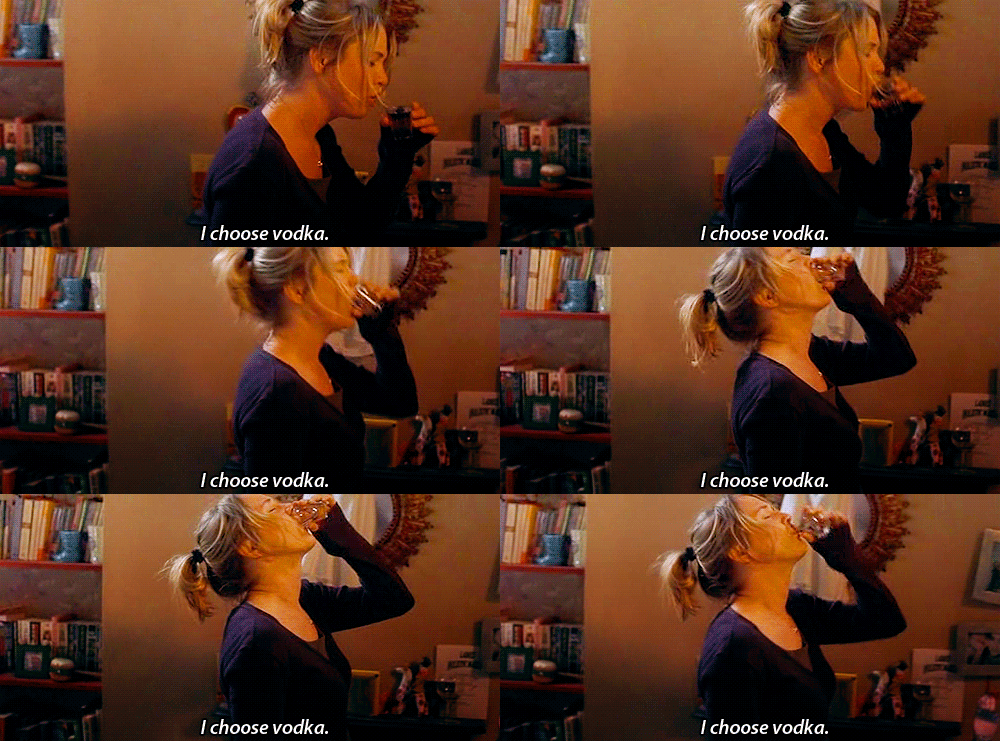
(this is my face throughout the entire month it took me to finish the book)

Warmest wishes and kind regards,

Mr Eagle

Wednesday, 18 December 2013

Kaip išgyventi Marijos žemėje

Po vizito gimtinėje mano knygų spintoje atsirado pora lietuviškų knygų, viena jų - Olego Lapino humoristinis veikalas 'Kaip išgyventi Marijos žemėje', pristatoma 'kaip trumpas vadovas, padėsiantis mums bei atvykėliams susigaudyti ir išgyventi Lietuvoje'.

Ponas Lapinas apžvelgia tokias svarbias temas, kaip sveikata, sportas, klimatas, istorija, pinigai ir pan. Viskas daroma su ironija, užuominomis į praeitį, kartu nepamirštant ir šiuolaikinių įvykių (knyga išleista 2010-aisiais ir aprašomų politinių peripetijų  jau tiesiog nepamenu). Skaityti paprasta, bet nuobodoka, o ir karikatūrinis 'tikro' lietuvio portretas po kokio trečio skyrelio man jau tapo nebemielas. Dar pilna prikišta anekdotų ir maždaug 10% jų yra juokingi.

Duočiau 2/5 ir kitiems skaityti nesiūlau.


Sunday, 15 December 2013

Literary Classics: Evelyn Waugh 'The loved one'

The book cover said 'One of the funniest and most significant books of the century' (Daily Telegraph). After I've read it, it got me thinking 'How different we read the books which were written almost a hundred year ago, and could we still find them shocking, funny or relevant?' Will Bridget Jones be hilarious in hundred years?
Well sometimes I think that for some books I already saw or read to much. For example, while I was reading Kafka's Metamorphosis I was thinking 'So what, he became a big bug. I've read a book telling a story of a woman turning to a pig and it was way more interesting'.
The Loved One falls in the category of books which I enjoy reading but do not recommending to others. It's witty, yes. It's darkly sarcastic, yes. The story is passable. The characters are satirically sketched. Is it funny? A bit. The old fashioned way. It got me to smile couple of times.
The love triangle between a failed Englishman writer who works in a pet funeral house ('Happier Hunting Ground', ha!), fragile Aimée and Mr Joyboy (both are working at the funeral house Whispering Glades, this one is for people) is the main storyline, decorated with a handful of mannerism, empty gestures and fancy words. It's a bit artificial. Take everything away and it's a simple story about self-centered failed writer, fragile girl and a middle-aged man who lives with his mother. They met, they fell in love, a girl could not choose, she made an wrong choice (well, IMHO). On the other hand, maybe it was author's intention to write an artificially decorated story which starts and leads nowhere. If it's true then the 'icing' is what really grasped my attention, the writing, the jeu de mots, Aimée and the Loved one.
On the bright side, author taught me one valuable lesson: never ask for a love advice from a newspaper's advice columnist. It can end disastrously. Maybe is not that valuable as no one does it anymore.

The enjoyable moment in the book is the description of English community in the US. The snobbishness, the feeling of superiority, and strict rules how an English gentleman should behave in the society.
  
I still do not understand how this book can be one of the most significant books of 20th century? And how long that list of "Most significant books of 20th century" is? I googled it. It doesn't exist (or it exists beyond third page of Google research which means that no one cares about it, so, [insert fancy Latin phrase here], it doesn't exist).
To read not for the story but for how it is told... hey, the daily work of funeral business does not shock me :)
p.s. for fancy Latin I would go for ipso facto but my knowledge of Latin is barely consisted of 5 expressions.

Veronica Roth and her Divergent trilogy

'Allegiant', the last book in the Divergent series, was published in October 2013 (and if the first movie will be successful, the adaptation of the third book will be divided into two parts to make more profit. Money make the world go 'round, the world go 'wound, the world go 'round...), so I thought that it's time to express my adoration.

Let's make one thing very clear: I adore dystopian novels. And this trilogy is a really good one. By good I mean it makes my inner teenage girl very haaaaaaappy.

There's a city (based on modern Chicago) where all people are divided into 5 factions according their aptitudes: Erudite (the smart), Candor (the truthful), Amity (the friendly), Dauntless (the fearless) and Abnegation (the selfless). According the factions all the tasks in managing the city are divided.

The story follows a 16 years old Abnegation girl Beatrice Prior who after her aptitude test understands that she is something different - a Divergent. And that being a Divergent is dangerous. She chooses to go to live in the other faction. The story continues during initiation process into Dauntless, follows the disagreement among the factions about the leadership, the power games, love stories, friendships and way more (if I told you, all the mysteries would be revealed).

In the last book it is revealed what is behind the city walls and disclosed why the factions were started at the first place.

It's a great read. Mostly the story is told through the main heroine who is a really well written and developed character. Being a Divergent, she has all the qualities to be a leader: she's smart, intuitive, brave, strong in spirit, and just. She faces the betrayal of her family, and is tormented by the idea that she had betrayed them at some extent as well. 'Thanks to' her small height she constantly being undervalued and it makes harder to prove her worth in a faction which values recklessness and strength. Also it's a self discovery: trying to understand who she is and what she was oppressing inside during the years in Abnegation faction. With the inevitable violent clash among the factions, she will deal with grief, guilt, sacrifice, and forgiveness. (I just love her!)

The character building is one of the strongest author's Veronica's Roth points. She manages to build complicated, likable (or unlikable) and 'real' (by that I mean that they do mistakes, have emotional issues, basically, all us... in dystopian world)  characters, she equally provides enough background details for each and everyone.
To my romantic readers: there also a love story, and a really lovely one. And Tobias is really worth our main heroine (also being attractive helps a bit).
Great story, great characters, great writing. If the Swedish would grade the books as they grade movies, this one would get an "A".

Which faction would you belong to?

p.s. I would say that Katniss and Tris would be frenemies in a dystopian Hunger Games-Divergent mash-up world :)

Romain Gary "La vie devant soi" ("The live before us")

Nailed it!!!

Yet another book in French in my 'read' section. And what a book!

Romain Gary is a well know French novelist who was born in my lovely homeland. He moved to France later one and consequently achieved great things (which can be easily googled). He had a spark, oh he did as he managed to win Prix Goncourt (a prestigious prize in French literature) twice; first one he won under his own name, and the second under pseudonym Emile Ajar for this particular book. Apparently Prix Goncourt can be given only once per lifetime, so the writer wanted to prove his literary talent by winning it twice, and oh he did it (snap, snap, snap).

The book was proposed to me by my French teacher as one of the assignments of this year. A great choice!

The story is told through the eyes of a kid who lives in a household with an old Jewish lady who can barely climb the stairs to her apartment on the sixth floor. This woman is 'hosting' a shelter for the prostitutes' kids. According the law of 1970's France, they cannot live with their mothers. So, women pay Madame Rosa to take care of their offsprings while they are working. Little Momo or Mohammed is one of the permanents in the house; he was left there as a small child and never saw neither his mother nor his father. His days are spent in the colourful Paris département, mixing with other kids, nationalities, and cultures. An old Arab carpet salesman is teaching him the "Arab ways" as Madame Rosa finds it necessary, though, the boy "did not know that he's Arab until he was insulted in school". Well, he does not go to school anymore as he was sent away because he looked "to young for his age". And his age is a number lost between fake documents, his own memories and the stories of Madame Rosa. Without an obligation to go to school, Momo spends his days observing, stealing and thinking. He sees the world around through his realistic, sarcastic and 'ugly truth' lens.  Though, he stays a kid imagining a lioness coming to lick him before the sleep as mother would come to kiss him goodnight. His relationship with Madame Rosa is the core of the book: and it's a mix of love, disdain, friendship, duty and mutual necessity. It becomes more tainted after Madame Rosa's health deteriorates and Momo has to be responsible for not letting her die in the hospital because the doctors simply won't let her die.

The writing is so vivid. Momo's language is full of street expressions, keen observation, sadness and sheer understanding of how the world works. No sugar coating needed. The other recurring characters are their own fantastic mysteries and great stories: Senegalese ex-boxer and now transvestite Madame Lola, Monsieur Wolumba who tries to heal Madame Rosa with African tribal rituals, a pimp who asks Madame Lola to write letters to his family, prostitutes who show much love for the main character. At the end it will be Momo who will stay by Madame Rosa's side until her last breath.

A valuable lesson on humanity, love and tolerance.

A must-read.

Andriaus Tapino „Vilko valanda“, arba „Moters teisė į blynus“

Pirmiausia išsakysiu nuomonę apie tą knygos vietą, kuri man sukėlė dabalju tė ef emocijas. Tai vat, pagrindinė herojė Mila, grįžusi iš ilgų ir nuotykių kupinų kelionių, prisėda pusryčiauti ir namų ekonomė jai prikepa kalną skaniausių blynų su uogiene ir klevų sirupu. Ir jinai juos kerta (nes blynus reikia kirsti, o ne valgyti). Ir kitą knygos pastraipa ne apie tai, kad blynai skanūs, ar ji pasiilgo ekonomės blynų, ar kad diena nusimatė labai graži. Ne, ne, ne. Tolesnė pastraipa yra apie tai, kad tuometinį Vilnių jau buvo užvaldžiusi lieknėjimo mada ir visos poniutės stengėsi tilpti į savo sukneles, bet Milai tai neturėjo rūpėti, nes kad ir ką ji valgė, į „kūną nėjo“ (ne citata, o liaudies kalba). WTF!?! Kai anksčiau J. Basanavičius knygoje valgė kepsnius, po šito lieknėjimo manijos aprašymas nesekė? O kodėl? Dabar išeina taip, kad autorius bando pateisinti tai, kad Mila valgė kalną blynų, nes kaip ir negalima... Na, bet kad jos metabolizmas buvo geras, tai tiek to jau – tegul valgo. Bet pateisinti jos valgymą buvo būtina. Net jei „į kūną“ tie blynai eitų, tai ar negali jinai jų suvalgyti. Žodžiu, aš pasisakau už moters teisę į blynus. Ir mano, ir Milos, ir bet kurios moters. Laisvę moteriai, valgančiai blynus!!!
O dabar grįžtu prie knygos. Andriaus Tapino „Vilko valanda“ yra steampunk žanro fantastikos knyga. Pridėjus šiek tiek fantazijos, sumaišius didžiąsias istorines pavardes (J. Basanavičius, P. Vileišis) su dabartiniais vilniečiais (Solomonas ir Roželė), pridėjus žiupsnelį naujų veidų, išeina labai geras mišinys. Veiksmas vyksta XX a. pradžioje viename iš kelių Rotčildų Aljansui priklausančių laisvųjų miestų – Vilniuje. Tai – alchemikų miestas, kuriame dunda dirba Garmiestis, Nekrikštuose lėbauja studentai, Bėdose vyksta nusikaltimai, Žvėryne – pensininkų ramybė, o sienas vis dar teplioja Solomonas. Konkurencija tarp alchemikų ir gaivintojų ložės yra nuožmi, Vilniaus legato viršininkas Antanas Sidabras bando tirti mįslingus nusikaltimus mieste, dar pridėkime Rusijos imperijos siekį provokuoti, skaldyti ir valdyti, ir voilà. Pasakojimas užburia ir pritraukia, jis yra sąmojingas (viešnamiai vadinami Pakantumo namais ir dar tie kryžiumi nešini Katedros riteriai), pilnas gyvos lietuvių kalbos, posakių, net tarmių. 
Klaidžioti kartu su autoriumi Vilniaus gatvėmis ir bandyti atspėti, kurioje dabartinio Vilniaus vietoje esame, yra fun fun fun. Taip pat skaityti lietuvių kalba, nes esu sau pasakius: jei galiu skaityti originalo kalba, tai kodėl to nepadarius. Be to, knygų vertimas į lietuvių kalbą ne visada yra labai geras... (žr. grupę feisbuke „Klaikūs vertimai“) Tad „Vilko valandos“ literatūrine kalba aš tiesiog mėgavausi. O tai svarbiausia skaitant knygą – mėgautis kalba ir pasakojimu. Tai nebuvo knyga, kurią surijau per dieną. Tai yra knyga, kai aš laikiausi, kad nesuryčiau per dieną, nes paprasčiausiai nesinorėjo baigti jos skaityti.
Tiesa, nežinau, kaip knygą priims vyresnė karta, ne vilniečiai ir užsieniečiai. Bet aš tai išbandysiu (su mama ir draugais užsieniečiais) ir kada nors tai aprašysiu.
Žodžiu, tegul viena WTF akimirka nesugadina medaus statinės. 
Verta dėmesio knyga.

Saturday, 12 October 2013

'Mad about the boy' by Helen Fielding


Spoiler alert!

Last year I got super excited about the comeback of Bridget Jones! All sorts of funny ideas were running through my head of how the book will turn out, and to my utter dismay, when the press tour started, I’ve learned that Mr Perfection, a.k.a. Mr Darcy is not that well… And I mean he’s really not well, because he’s dead! I was reluctant to read the book at first and considered to stay living in a bubble where Mark Darcy is still strutting down the streets of London in his black coat, but when an email from Amazon appeared in my inbox announcing its new releases and I saw Helen Fielding’s ‘Mad about the boy’ being live, I took my credit card out and got sucked into the world of Bridget Jones.

‘Mad about the boy’ starts four years after Mark’s death with 51 year old Bridget being single mom of two and entering the dating scene once again. Of course, the world has changed a great deal when she was last single and now our Bridget has to deal with all kinds of confusing new things like Twitter, texting (or sexting), cougars and online dating and she’s still obsessive about her weight and alcohol units. Helen Fielding plays with these comic elements beautifully! 

But let’s talk about the romance, shall we? After some serious flirting on Twitter, Bridget has gotten herself a toy boy and is dealing with the age difference issues and awkward social situations.  But the age gap is proven to be too big at the end and Bridget is entering the singledom again. There is another character present throughout the book and as if to compensate for the cruel blow she has given to Bridget, author has paired her with this man who is even more perfect than Mr Perfection (Darcy) himself. Lightning doesn’t struck twice they say? Some would think that one slightly odd and confused woman can’t possibly be so lucky for the second time, but I think for all the fans of this story that has always been part of the character's appeal – the ordinary heroine who wins her man not by being the perfect woman, but by being herself. Embrace your inner Bridget, ladies! 

The scenes in the book when she’s missing Mark are painstakingly tearful… I’ve seen so many angry comments and fans being gobsmacked about killing off Mark, but life is not perfect and not every great romance has a happy ending, right? And still ‘Mad about a boy’ is worth 4 stars to me, purely because world without Mark Darcy won’t ever be the same.